I've always been a proponent of eating your own dogfood - if you recommend a product you should use it.
Well I've been using evernote for about a month now, and have imported all my One Note notebooks into Evernote - sorry Microsoft, the lack of a Mac client in the end was just too much of pain.
And I've found it really useful, building notebooks for individual projects as well as organising material - but you do need to be systematic and tag documents and note properly - it's no use tagging one document 'sighelm' and another 'silk road', you have got to make the conscious engaged decision to say that 'this clipping is useful for the Sighelm document, and for a more general background on trade and linkages via central asia'.
This actually is good as it makes you think critically about what you are noting and how it will be of use in the future.
And of course you can search for tags across notebooks, as well as dynamically reorganise notebooks, making it easy to reaorganise material as needed.
The other great thing I've found is the iPhone application - you take your phone with you everywhere, meaning that you can take your notes everywhere, and consequently can pull up and find the document that you forgot for the meeting, or indeed at that moment when inspiration strikes - I'm almost convinced enough to buy an iPad ...
Monday, 21 March 2011


Friday, 18 March 2011
Ah well, there's still the Guardian ....
The New York Times has finally announced its paywall, which is not exactly a model of transparency but as far as I'm concerned has a simple result - access to one of the great liberal newspapers of the world has been turned off.
Now you could argue that I should subscribe to the Times, but it doesn't make sense - living in Australia most of the content is less than relevant - most days I skim the world news and tech headlines and read the odd article that's not syndicated elsewhere. I probably read more than 20 a month but less than 50, and that's simply not worth $15 a month.
However, it probably won't have any major effect. Sure I might miss a useful article or two, but I can live with that. What I will miss is an alternative viewpoint and a foil to the Guardian ...
Now you could argue that I should subscribe to the Times, but it doesn't make sense - living in Australia most of the content is less than relevant - most days I skim the world news and tech headlines and read the odd article that's not syndicated elsewhere. I probably read more than 20 a month but less than 50, and that's simply not worth $15 a month.
However, it probably won't have any major effect. Sure I might miss a useful article or two, but I can live with that. What I will miss is an alternative viewpoint and a foil to the Guardian ...
Tuesday, 8 March 2011
Bear Grylls and the Boar of Calydon
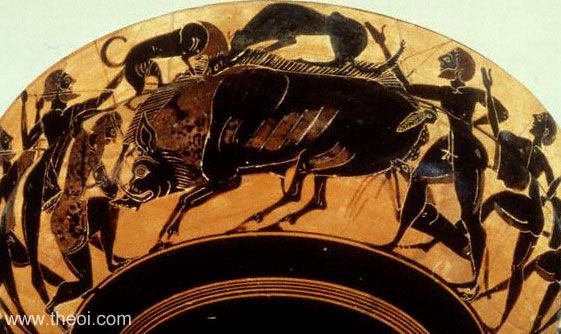
last night, J and I decided to abandon the wild intellectual ferment of life and blob out with a hour or so's tv by watching 'Man versus Wild' on SBS.
In last night's episode Bear was doing his thing shinning down trees and building humpies in the woods of a distinctly wintry looking northern Alabama, and building traps with his usual lack of success in the squirrel killing department.
He was then provided with a tethered (and extremely pissed off) feral pig to dispatch.
What was interesting was how snout curlingly aggressive this feral pig was and being on a long leash how difficult it was to get hold of, jumping, jinking and sliding out of Bear's grasp. He was eventually reduced to jumping on it to pin it down.
Now we could argue about the morality of killing an animal for a tv show, but I'm guessing, that like in Australia, feral pigs in Alabama are a nuisance and a menace and as a consequence men with a penchant for beer, checked shirts and guns are allowed to go kill them, and occasionally get injured by a pissed off pig.
However, watching Bear Grylls try to catch and kill a pig showed just how difficult and dangerous the enterprise would be when armed only with spears and clubs - it was a much more hard core business to chase down a pig and kill it, and why a pig or boar was a fierce adversary and used as a symbol by at least one Roman legion ...
Bookstores and information services
couple of things from the department of coincidences:
Bookstores
Monday night's ABC news in Canberra had a report on how bookstores are changing, which is now (three days after broadcast) online. It included interviews with the managers of two of the biggest non-chain bookstores who said that while sales are down, maintaining ambience and having helpful staff seemed to help.
Interestingly, one bookshop, Smith's, said they'd applied for a liquor licence for their in-store coffee shop ...
University Information Services
Today's SMH had a slightly emotional front page report on how UNSW are reducing their book holdings and making space in libraries to provide laptop workspaces for students
Bookstores
Monday night's ABC news in Canberra had a report on how bookstores are changing, which is now (three days after broadcast) online. It included interviews with the managers of two of the biggest non-chain bookstores who said that while sales are down, maintaining ambience and having helpful staff seemed to help.
Interestingly, one bookshop, Smith's, said they'd applied for a liquor licence for their in-store coffee shop ...
University Information Services
Today's SMH had a slightly emotional front page report on how UNSW are reducing their book holdings and making space in libraries to provide laptop workspaces for students
Monday, 7 March 2011
Bookstores ...
In order to prove to ourselves that we have a life, J and I went to the movies last night - the King's Speech - and pretty damn good it was too.
Now we went to see it at the Dendy, a multiplex in the Canberra Centre, which is a massive mall in the centre of the city, because (a) parking's easy and (b) we thought we might go for a drink or some food afterwards. We of course arrived a little too early for the movie, leaving us with twenty or so minutes to kill, and for all of its glitz, the Canberra Centre is pretty well all closed at 6pm on a Sunday evening.
However Borders was still open.
One of the tropes of this blog is that bookstores are dying killed by ebooks and online sales. And that's undoubtedly true. Borders (which in Australia is a franchise operated by A&R), is in administration with the rest of A&R, and Borders in the states has filed for chapter 11.
So in we walked, past the various legal notices about being in administration, what was going to happen about giftcards, through the display of ereaders - which struck me as a bit like Christmas turkeys hosting a display of kitchen equipment, into the store. Our ostensible reason was to look at the travel books - we've an upcoming trip to Thailand - but actually it was to go and surf the books.
And it was an enjoyable twenty minutes - definitely bookshop porn - we looked at art books on Bhuddist sculpture, books about cats and even a book about soup. And it reminded me that bookshops are not just about buying books, but also about the pleasure of happenstance while surfing the shelves and finding an interesting and unexpected book or a new author, or just something different.
Now bookshops do have a problem with the rise of mail order and ebooks, and the fact that increasingly kids don't read - after all who wants to read Chekhov, Tolstoy or Thucydides when you've got Facebook and YouTube? Instant gratification always tops long books by men with beards, but our little surf did remind me of the sheer sensuousness of books.
Borders, of course, made book buying enjoyable by allowing people to browse, sofas on which to read before deciding to buy and a cafe for literary types to meet and chat. And of course this was exploited by people who just wanted a coffee and to use the free wi-fi, or indeed as I admit to doing, finding an interesting book, photographing its cover, and buying online.
Perhaps there is a third way, where bookstore promote themselves as social focii for booklovers and to encourage people to come and surf the shelves as well as to meet and interact. Bookstores are culturally important for the sheer happenstance of browsing - something that you simply don't get online. For exaple Amazon's recommendations are often interesting, but are based on both your buying history and what people with similar interests bought. Which means if you're interested in the anglosaxon period you might happen across an interesting new book on the topic, or if you have a secret addiction to Lindsey Davis novels get a new author of similar books suggested, but you'd almost certainly never get a book on soup or literary quotes about cats recommended to you.
So, help support you local bookstore - if you enjoy visiting it, go buy a book from it - because, as I've just realised, you'll definitely miss it when it's gone ...
Now we went to see it at the Dendy, a multiplex in the Canberra Centre, which is a massive mall in the centre of the city, because (a) parking's easy and (b) we thought we might go for a drink or some food afterwards. We of course arrived a little too early for the movie, leaving us with twenty or so minutes to kill, and for all of its glitz, the Canberra Centre is pretty well all closed at 6pm on a Sunday evening.
However Borders was still open.
One of the tropes of this blog is that bookstores are dying killed by ebooks and online sales. And that's undoubtedly true. Borders (which in Australia is a franchise operated by A&R), is in administration with the rest of A&R, and Borders in the states has filed for chapter 11.
So in we walked, past the various legal notices about being in administration, what was going to happen about giftcards, through the display of ereaders - which struck me as a bit like Christmas turkeys hosting a display of kitchen equipment, into the store. Our ostensible reason was to look at the travel books - we've an upcoming trip to Thailand - but actually it was to go and surf the books.
And it was an enjoyable twenty minutes - definitely bookshop porn - we looked at art books on Bhuddist sculpture, books about cats and even a book about soup. And it reminded me that bookshops are not just about buying books, but also about the pleasure of happenstance while surfing the shelves and finding an interesting and unexpected book or a new author, or just something different.
Now bookshops do have a problem with the rise of mail order and ebooks, and the fact that increasingly kids don't read - after all who wants to read Chekhov, Tolstoy or Thucydides when you've got Facebook and YouTube? Instant gratification always tops long books by men with beards, but our little surf did remind me of the sheer sensuousness of books.
Borders, of course, made book buying enjoyable by allowing people to browse, sofas on which to read before deciding to buy and a cafe for literary types to meet and chat. And of course this was exploited by people who just wanted a coffee and to use the free wi-fi, or indeed as I admit to doing, finding an interesting book, photographing its cover, and buying online.
Perhaps there is a third way, where bookstore promote themselves as social focii for booklovers and to encourage people to come and surf the shelves as well as to meet and interact. Bookstores are culturally important for the sheer happenstance of browsing - something that you simply don't get online. For exaple Amazon's recommendations are often interesting, but are based on both your buying history and what people with similar interests bought. Which means if you're interested in the anglosaxon period you might happen across an interesting new book on the topic, or if you have a secret addiction to Lindsey Davis novels get a new author of similar books suggested, but you'd almost certainly never get a book on soup or literary quotes about cats recommended to you.
So, help support you local bookstore - if you enjoy visiting it, go buy a book from it - because, as I've just realised, you'll definitely miss it when it's gone ...
Thursday, 3 March 2011
Crunchbang 10
I've had some good experiences in the past with Crunchbang, a lightweight linux distribution, so when a new version came along I thought I'd have a go at building a VM on virtualbox to see how it went.
Previous versions have been based on the Ubuntu kernel, but the current version is based on debian - debian squeeze to be exact.
There is a choice of window manager - Open Box or Xfce. Of the two Open Box is a bit more minamalist in style. Xfce is the same window manager as is found in Xubuntu, has a slightly less hardcore feel, and which I used successfully on my old ppc imac when I was playing with some things.
The website gives you a choice of downloading an openbox iso or an xfce iso - unless your target machine is very tight for disk space it doesn't really matter which you download. Likewise, most machines, including those a few years old which are in their second or third incarnation, will have enough memory these days to run either window manager.
I chose the open box version. The text based install worked well, nothing really confusing, and in the most part taking the default option is fine. The only little gotcha I found was that if you set your preferred language to 'British English' by default you get a UK keyboard map.
Here in Australia, while we're closer to British English than American in usage, we do use US keyboards. However it's a trivial post install fix.
The first time you boot into Open Box you get the option of running a post install script to install various options not installed by default, such as Open Office, Java Runtime support and Xfce as an alternative desktop. If you install Xfce, you can of course change it to be your default if you don't get on with Open Box.
A nice touch, given that Crunchbang could well end up on netbooks (there is a special netbook install for the Eee available) and old laptops taken travelling - for example before netbooks were widely available I used to take an old macbook when going to wilder places on the basis I wouldn't be too hacked off if it got stolen or broken - is to also provide an optional install for dropbox.
That way of course all your valuable content can be synced painlessly to your main machine. And of course dropbox can be used to allow people doing things like research in libraries to again painlessly sync content across machines.
Given my experiments with Evernote, the syncing muliplatform notebook application, I thought I would install the latest version of Nevernote, the open source alternative Evernote client.
This just worked. A minor annoyance was that under Open Box it didn't add itself to the applications menu, but it did so under Xfce.
The only surprise with Crunchbang is that the default browser is Chromium - essentially an open source version of Google's Chrome, rather than the more common Mozilla Firefox. Wikipedia has a good article on Chromium, and if it doesn't work for you, installing Firefox should be straightforward.
So, impressive. Impressive enough to try on a 'real' old machine, such as the old (2000-vintage) Toshiba satellite that used to be my work machine and still has Windows 2000. Given it's gathering dust and hasn't been powered on for two or three years, it would probably give it an option to go out in a blaze of glory ...
Previous versions have been based on the Ubuntu kernel, but the current version is based on debian - debian squeeze to be exact.
There is a choice of window manager - Open Box or Xfce. Of the two Open Box is a bit more minamalist in style. Xfce is the same window manager as is found in Xubuntu, has a slightly less hardcore feel, and which I used successfully on my old ppc imac when I was playing with some things.
The website gives you a choice of downloading an openbox iso or an xfce iso - unless your target machine is very tight for disk space it doesn't really matter which you download. Likewise, most machines, including those a few years old which are in their second or third incarnation, will have enough memory these days to run either window manager.
I chose the open box version. The text based install worked well, nothing really confusing, and in the most part taking the default option is fine. The only little gotcha I found was that if you set your preferred language to 'British English' by default you get a UK keyboard map.
Here in Australia, while we're closer to British English than American in usage, we do use US keyboards. However it's a trivial post install fix.
The first time you boot into Open Box you get the option of running a post install script to install various options not installed by default, such as Open Office, Java Runtime support and Xfce as an alternative desktop. If you install Xfce, you can of course change it to be your default if you don't get on with Open Box.
A nice touch, given that Crunchbang could well end up on netbooks (there is a special netbook install for the Eee available) and old laptops taken travelling - for example before netbooks were widely available I used to take an old macbook when going to wilder places on the basis I wouldn't be too hacked off if it got stolen or broken - is to also provide an optional install for dropbox.
That way of course all your valuable content can be synced painlessly to your main machine. And of course dropbox can be used to allow people doing things like research in libraries to again painlessly sync content across machines.
Given my experiments with Evernote, the syncing muliplatform notebook application, I thought I would install the latest version of Nevernote, the open source alternative Evernote client.
This just worked. A minor annoyance was that under Open Box it didn't add itself to the applications menu, but it did so under Xfce.
The only surprise with Crunchbang is that the default browser is Chromium - essentially an open source version of Google's Chrome, rather than the more common Mozilla Firefox. Wikipedia has a good article on Chromium, and if it doesn't work for you, installing Firefox should be straightforward.
So, impressive. Impressive enough to try on a 'real' old machine, such as the old (2000-vintage) Toshiba satellite that used to be my work machine and still has Windows 2000. Given it's gathering dust and hasn't been powered on for two or three years, it would probably give it an option to go out in a blaze of glory ...
Tuesday, 1 March 2011
Nevernote 0.97
Following on from my struggles with NeverNote on a Dell laptop, I fired up my ubuntu VM and tested 0.96 again, where it ran perfectly if a tad slowly, forcing me to conclude that there must be some weird lowlevel java problem on the Dell.
As Nevernote 0.97 has been released, I decided to build a debian vm and see if it worked (if I was being strict about a test regime I should of course tested against Ubuntu 10.10, but I wanted to see what Debian was like these days).
After a minor struggle during which I discovered (a) I didn't know how to drive KDE anymore (b) java wasn't installed by default, I installed NeverNote 0.97 and it basically worked. A few minor display issues on some webclippings, but basically it worked.
So my advice is this:
As Nevernote 0.97 has been released, I decided to build a debian vm and see if it worked (if I was being strict about a test regime I should of course tested against Ubuntu 10.10, but I wanted to see what Debian was like these days).
After a minor struggle during which I discovered (a) I didn't know how to drive KDE anymore (b) java wasn't installed by default, I installed NeverNote 0.97 and it basically worked. A few minor display issues on some webclippings, but basically it worked.
So my advice is this:
- Try installing 0.97 on linux, there is no reason why it should not work for you
- If it hangs with Qt.Jambi errors try the 0.92 version - this one works for me
Subscribe to:
Posts (Atom)